Underground Railroad Discovered At Manhattan’s Merchant’s House Museum

Underground Railroad Discovered At Manhattan’s Merchant’s House Museum


Share this post

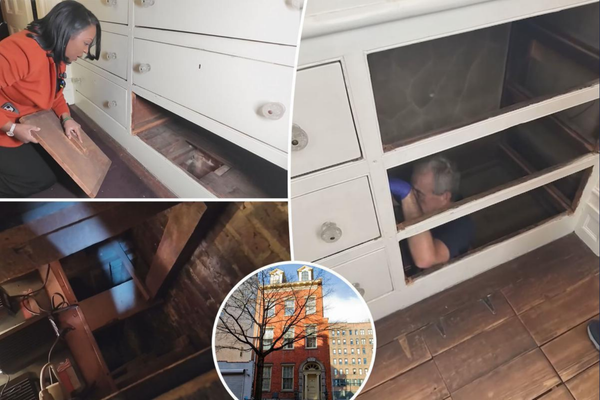
The Merchant’s House Museum, a slim 19th-century townhouse in Manhattan’s NoHo neighborhood, has discovered a link to the underground railroad just in time for Black History Month. Spectrum New York News 1 broke the news on Tuesday (Feb. 9).
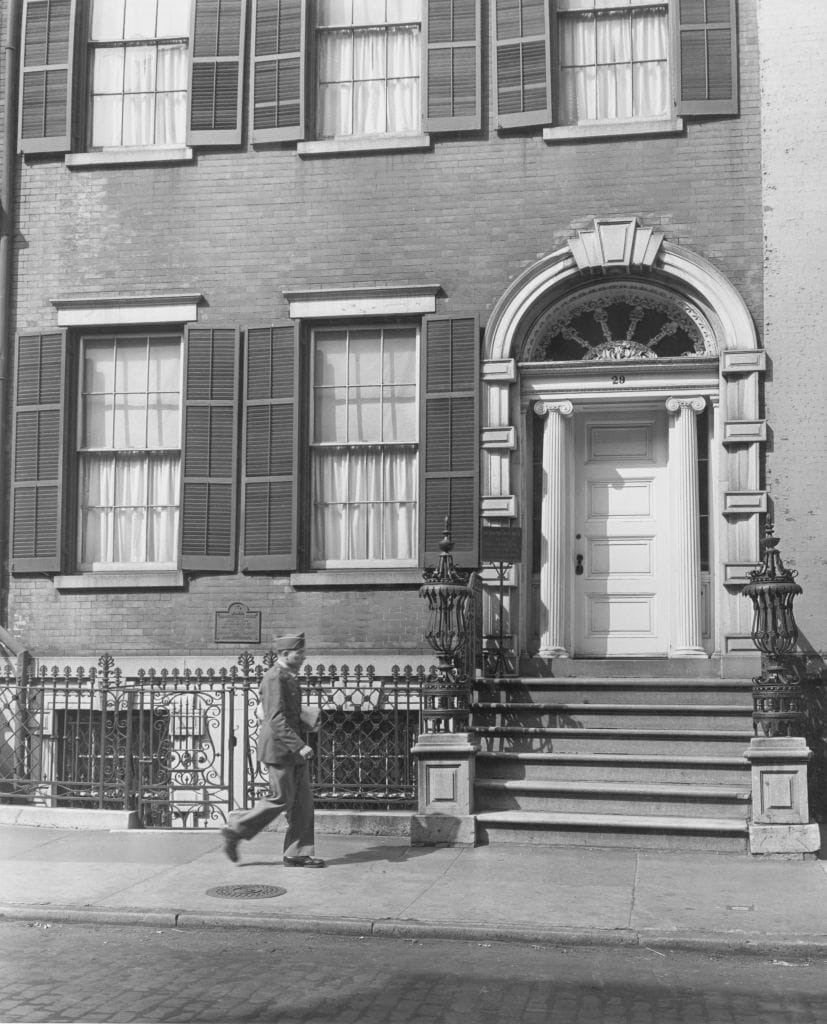
The Old Merchant's House or Seabury Tredwell House, later the Merchant's House Museum, at 29 East Fourth Street in Manhattan, circa 1945. It was built in 1832 and designed by Minard Lafever. (Photo by Lawrence Thornton/Archive Photos/Getty Images)

Located on East Fourth Street, the building is long celebrated for its preservation of the “old New York.” The building’s underground railroad discovery is set as a concealed passageway hidden inside the landmarked home, which likely served as a safe haven for enslaved Africans fleeing the South.

Built in 1832 and opened as a museum in 1936, the former Treadwell family home showcases a ruby-red parlor with the original piano and a cast-iron stove in the kitchen. It attracts tourists seeking a glimpse of Manhattan’s history.

The underground railroad was discovered by experts upstairs, behind built-in drawers along the west wall. The railroad was part of a pivotal change for Blacks during the salvery era.

“We knew it was here but didn’t really know what we were looking at,” curator Camille Czerkowicz said.

After removing a heavy bottom drawer, investigators uncovered a rectangular cut in the floorboards. The opening leads to a tight, two-by-two-foot shaft with a ladder descending to the ground floor. Historians describe the design as deliberate and nearly invisible.

“I’ve been practicing historical preservation law for 30 years, and this is a generational find,” said Michael Hiller, a preservation attorney and Pratt Institute professor. “This is the most significant find in historic preservation in my career, and it’s very important that we preserve this.”

Architectural historian Patrick Ciccone credits builder Joseph Brewster, who sold the house in 1835, with embedding the hidden feature.

“Being an abolitionist was incredibly rare among white New Yorkers, especially wealthy white New Yorkers,” Ciccone said. “[Joseph Brewster] was the builder of the house, and he was able to make these choices and design it.”

City leaders say the find reshapes Manhattan’s historical narrative. “Many New Yorkers forget that we were part of the abolitionist movement,” Councilman Christopher Marte said. “This is physical evidence of what happened.”

Councilman Harvey Epstein called it “a critical piece of the overall struggle for freedom and justice.”

Now, the Merchant’s House Museum offers more than antique elegance. It stands as living proof that Manhattan once played a quiet but courageous role in the fight for freedom.



Share this post
Comments

Be the first to know

Join our community and get notified about upcoming stories

Subscribing...
You've been subscribed!
Something went wrong
Remembering James Van Der Beek: Dawson’s Creek Star Passes Away at 48

Remembering James Van Der Beek: Dawson’s Creek Star Passes Away at 48

James Van Der Beek, best known for playing Dawson Leery on Dawson’s Creek, has died at 48 after a years‑long battle with colorectal cancer. His wife, Kimberly Van Der Beek, announced that he “passed peacefully this morning,” saying he met his final days with “courage, faith, and grace,” and asked for privacy for their family in an Instagram post titled “Our beloved James David Van Der Beek passed peacefully this morning.” Van Der Beek revealed in November 2024 that he had been diagnosed with st


B P

After Sonya Massey’s Death, An Illinois Jury Delivers a Rare Murder Verdict

After Sonya Massey’s Death, An Illinois Jury Delivers a Rare Murder Verdict

In July 2024, Sangamon County sheriff’s deputy Sean Grayson responded to a 911 call from 36‑year‑old Sonya Massey, a Black woman in Springfield, Illinois, who had reported a possible intruder at her home. Body‑camera footage shows deputies asking her to check a pot of hot water on the stove, warning “we don’t need a fire while we’re here,” then Grayson shouting that he would shoot her “right in the face” before ordering her to drop the pot and firing as she ducked and apologized; investigators l


B P

Seventeen’s Tiny Desk Proves K‑Pop Has Officially Cracked the “Serious Music” Canon

Seventeen’s Tiny Desk Proves K‑Pop Has Officially Cracked the “Serious Music” Canon

Seventeen just made Tiny Desk history as the first K‑pop group to perform an in‑office concert at NPR, delivering a nine‑song medley with a live band squeezed behind the famous shelves. The set, which Music Connection highlighted in its January “Song Biz” column, strips away arena‑scale production in favor of tight harmonies, reworked choreography for a cramped stage and arrangements tailored to Tiny Desk’s intimate, musician‑forward format. With only part of the group present and an audience o


B P

The Max Mara Art Prize for Women Goes Global, Starting With Jakarta

The Max Mara Art Prize for Women Goes Global, Starting With Jakarta

The Max Mara Art Prize for Women is entering a new phase, bringing in New York–based curator Cecilia Alemani to oversee its 10th edition and adopting a nomadic format that debuts with Jakarta’s Museum MACAN. As noted in ArtAsiaPacific’s “Weekly News Roundup: January 26, 2026”, the prize, launched in 2005 for women artists working in the UK and long tied to London’s Whitechapel Gallery, will now travel to a different country for each edition while still offering a six‑month residency in Italy and


B P