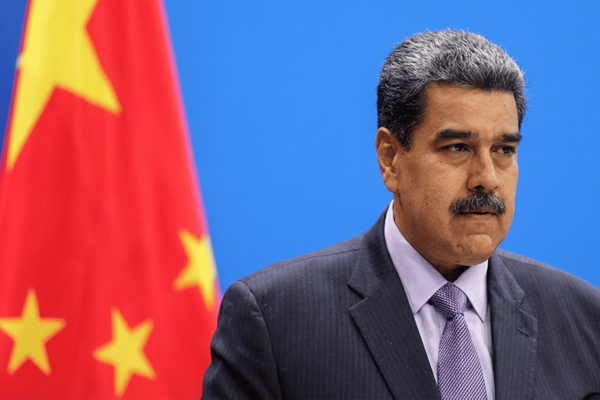
US President Donald Trump said on Saturday that Venezuelan President Nicolas Maduro and his wife, Cilia Flores, had been extracted from Venezuela by US forces and would be taken to New York to face federal charges, as governments around the world condemned or expressed concern over Washington’s military action.
Speaking in a telephone interview with Fox News from West Palm Beach, Florida, Trump said Maduro and his wife were removed by helicopter and transferred to a ship.
“They’re on a ship but they’ll be heading into New York. The helicopters took them out,” he said.
Trump added that the United States would play a central role in shaping Venezuela’s future following Maduro’s capture.
“We’ll be involved in it very much. And we want to do liberty for the people,” he said, adding that Washington would not allow anyone to “take over where he left off”.
Earlier, Trump said US special forces had captured Maduro following overnight air strikes on Caracas and other locations. The Venezuelan government has accused the United States of “extremely serious military aggression” and demanded proof that Maduro is alive.
Venezuelan Vice President Delcy Rodriguez said she did not know the whereabouts of Maduro or Flores and called on Washington to provide “proof of life”. Speaking by telephone to state television, she said the government was seeking urgent clarification following the strikes.
US Vice President JD Vance said Venezuela had ignored opportunities to de-escalate the crisis.
“The president offered multiple off ramps, but was very clear throughout this process: the drug trafficking must stop, and the stolen oil must be returned to the United States,” Vance wrote on X.
“You don’t get to avoid justice for drug trafficking in the United States because you live in a palace in Caracas,” he added.
The Trump administration has long accused Maduro of heading a drug trafficking network, charges rejected by Caracas, which says Washington is seeking to overthrow the government because of Venezuela’s oil reserves.
International reaction was swift. The European Union urged restraint and respect for international law. EU foreign policy chief Kaja Kallas said the bloc had “repeatedly stated that Mr Maduro lacks legitimacy” but stressed that “under all circumstances, the principles of international law and the UN Charter must be respected. We call for restraint.”
European Commission President Ursula von der Leyen said the EU stood by the Venezuelan people and supported “a peaceful and democratic transition”, while European Council President Antonio Costa called for de-escalation.
Spain offered to mediate in the crisis. Its foreign ministry said Madrid called for “de-escalation and restraint” and stood ready to help in the search for “a democratic, negotiated, and peaceful solution”.
Chile’s President Gabriel Boric condemned the US action, saying his government expressed “concern and condemnation of the military actions by the United States taking place in Venezuela” and called for a peaceful resolution in line with international law.
Brazilian President Luiz Inácio Lula da Silva described the US strikes and Maduro’s capture as a “serious affront” to Venezuelan sovereignty, saying they crossed “an unacceptable line” and threatened regional peace. He urged the United Nations to respond “vigorously”.
Russia, a close ally of Caracas, condemned what it described as US “armed aggression” and demanded “immediate clarification” about Maduro’s fate.
“We are extremely alarmed by reports that Venezuelan President Nicolas Maduro and his wife were forcibly removed from the country,” the Russian foreign ministry said.
Turkey also called on all sides to act with restraint to prevent wider regional and international consequences.
China urged its citizens in Venezuela to avoid travelling and to stay away from sensitive areas, advising those already in the country to strengthen safety precautions.
In the United Kingdom, Prime Minister Keir Starmer said all countries should “uphold international law” and stressed that Britain “was not involved in any way in this operation”. He said the situation was “fast-moving” and that the government’s priority was the safety of around 500 British nationals in Venezuela. The Foreign Office updated its travel advice to warn against all travel to the country.
Colombian President Gustavo Petro said he had ordered the deployment of security forces to the Venezuelan border, describing the US action as an “assault on the sovereignty” of Latin America and warning of a potential humanitarian crisis.
No independent confirmation has yet been provided of Maduro’s location or condition. Trump said he would address the situation further at a news conference later on Saturday.