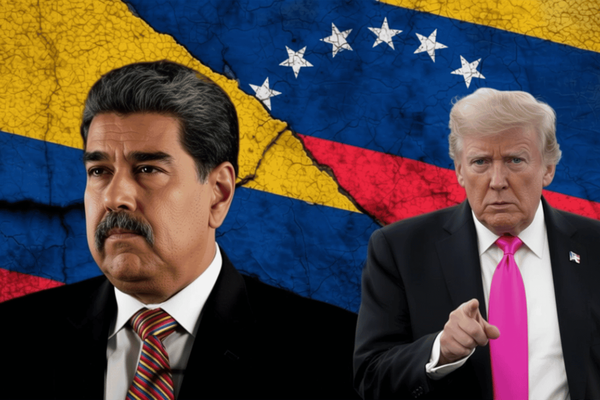
US President Donald Trump on Saturday claimed that American forces had captured Venezuelan President Nicolás Maduro following air strikes on Caracas and other cities, marking a dramatic escalation in a months-long confrontation between Washington and the Caracas government.
In a rapidly unfolding sequence of events, residents of the Venezuelan capital were jolted awake by explosions and the sound of attack helicopters at about 2:00 am local time (0600 GMT). AFP journalists reported that the strikes, which targeted a major military complex, an airbase and other sites, continued for nearly an hour.
“The United States of America has successfully carried out a large-scale strike against Venezuela and its leader, President Nicolás Maduro, who has been, along with his wife, captured and flown out of the country,” Trump said in a post on his Truth Social platform roughly two hours after the attacks began.
US Attorney General Pamela Bondi said in a separate post on X that Maduro and his wife, Cilia Flores, would face “the full wrath of American justice on American soil in American courts” over drug trafficking and terrorism charges.
Deputy Secretary of State Christopher Landau also wrote on X that it marked “a new dawn for Venezuela”, adding: “A tyrant is gone.”
The Venezuelan government swiftly condemned what it described as an “extremely serious military aggression” by the United States and called for an emergency meeting of the United Nations Security Council.
Speaking by telephone to state television, Vice President Delcy Rodríguez said she did not know the whereabouts of Maduro or his wife and demanded that Washington provide “proof of life” for the leader, who has ruled Venezuela for the past 12 years.
Maduro’s re-election in 2024 was widely dismissed by much of the international community as fraudulent.
Russia, a key ally of Caracas, condemned what it termed “armed aggression” and demanded “immediate” clarification on Maduro’s fate, according to a statement from its foreign ministry.
US Senator Mike Lee said he had spoken with Secretary of State Marco Rubio, who told him that Maduro would “stand trial” in the United States, where he is wanted on charges linked to drug trafficking.
Trump announced that he would hold a news conference at 11:00 am (1600 GMT) at his Mar-a-Lago residence in Florida, where he is currently on holiday.
Venezuelan opposition leader and Nobel Peace Prize laureate María Corina Machado had not reacted publicly by Saturday afternoon. In a post on X on December 31, she had written that she was confident 2026 would bring the “consolidation of our nation’s liberty”.
‘A brilliant operation’
Venezuela has for months braced for possible US military action following repeated threats by Trump to intensify pressure on Maduro’s administration.
In a brief telephone interview with The New York Times, Trump described the operation as “brilliant”, saying it involved “a lot of good planning and a lot of great, great troops and great people”.
Among the reported targets were Fort Tiuna, Venezuela’s largest military complex in southern Caracas, and the Carlota airbase in the north of the capital. La Guaira, north of Caracas and home to the country’s main airport and port, was also hit.
“I felt like the explosions lifted me out of bed, and I immediately thought, ‘God, the day has come,’ and I cried,” said Maria Eugenia Escobar, a 58-year-old resident of La Guaira.
The government said Maduro had declared a state of emergency, but the 63-year-old socialist leader, who as recently as Thursday had offered to cooperate with Washington, was not seen publicly.
The defence ministry accused the United States of striking residential areas and announced a “massive deployment” of military resources.
Iran and Cuba condemned the attacks, while Colombian President Gustavo Petro also criticised the strikes and said he was deploying troops to Colombia’s border with Venezuela.
The European Union’s top diplomat urged restraint during a call with Rubio, while Spain offered to mediate in an effort to secure a negotiated solution.
No casualty figures were immediately available.
As the bombing began, residents of Caracas rushed to windows and balconies to understand what was happening, while others took shelter in windowless spaces to avoid flying glass.
Social media reactions were sharply divided, with some users celebrating Trump’s claim that Maduro had been removed, and others condemning what they described as reckless warmongering.
‘They’re bombing’
Francis Peña, a 29-year-old communications professional in eastern Caracas, said he was woken by his girlfriend saying: “They’re bombing.”
“I can’t see the explosions, but I hear the planes. We’re starting to prepare a bag with the most important things at home — passport, cards, cash, candles, a change of clothes, canned food,” he said.
Trump had deployed an aircraft carrier and several warships to the Caribbean late last year, initially framing the move as part of an anti-drug smuggling operation. In recent weeks, however, he made clear his desire to see Maduro removed from power.
On Monday, Trump said it would be “smart” for the Venezuelan leader to step down and announced that the US had destroyed a docking area allegedly used by Venezuelan drug traffickers.
Washington has accused Maduro of leading a drug cartel, claims Caracas has dismissed as an attempt to justify regime change, arguing that the real motive is Venezuela’s vast oil reserves — the largest known in the world.
As pressure mounted, the US informally closed Venezuelan airspace, imposed additional sanctions and seized tankers carrying Venezuelan oil. Since September, US forces have also carried out multiple strikes on vessels in the Caribbean Sea and eastern Pacific Ocean, targeting what Washington says are drug smugglers. According to the US military, at least 107 people have been killed in those operations.