President Trump’s unexpected plan to impose a 25 percent tariff on cars and car parts imported into the United States will not only disrupt supply chains. It will also fuel anger and alienation — and pressure to retaliate — among American allies across the globe.
Many of the countries most affected by the new levies, such as South Korea, Japan, Germany, Mexico and Canada, are already reeling from the Trump team’s disregard for free trade deals already signed and his threats to long-established security relationships.
Prime Minister Mark Carney of Canada said on Wednesday that Trump’s move on tariffs was “a direct attack.” Ursula von der Leyen, president of the European Commission, said the result would be “bad for businesses” and “worse for consumers.” Robert Habeck, Germany’s acting economics minister, said, “It is now important for the E.U. to respond decisively to the tariffs — it must be clear that we will not back down in the face of the U.S.”
Other leaders reacted in muted terms, hinting that they were still considering how to respond, with another round of tariffs, in addition to this one, expected in early April.
“We need to consider what’s best for Japan’s national interest,” Prime Minister Shigeru Ishiba of Japan told Parliament on Thursday. “We’re putting all options on the table in considering the most effective response.”
The tariffs, which threaten both American and foreign carmakers, increase the likelihood of a global trade war. A chain reaction of economic nationalism with tariffs and other measures — perhaps adding costs for finance and services — could suppress economic growth globally, spread inflation and add rancor to already testy negotiations with Washington about security.
The Trump White House has sought to use every tool of American power, including its military support and consumer market, to extract what Mr. Trump sees as a better deal for Americans. But for countries that have spent decades trusting America and tying their economies and defense plans to Washington’s promises, this feels like a moment of reversal.
American influence, long built on pronouncements about values and the shared riches of free trade, has hardened into what many analysts describe as “all stick, no carrot.” In the Trump team’s thinking, critics argue, American gains require pain for others — friends included.
“Everything is a status competition or a dominance competition,” said Andrew Kydd, a political scientist at the University of Wisconsin who incorporates psychology into studies of international relations. “I think this is characteristic of extremists of all stripes — everything is about exploitation and domination, and to think otherwise is to be blind or naïve.”
As a result, he added, other countries “have to take seriously the articulated goals, however alarming.” That includes threats to seize Canada, Greenland and the Panama Canal, plus demands for economic submission to tariffs that weaken the economies of allies.
The European Union, which governs trade policies for its 27 member states, has been working for months on proposals for counter-tariffs if necessary. Those are designed to target areas of the United States that supported Mr. Trump in the last election. The United States is the E.U.’s largest trade partner, with nearly a trillion dollars of two-way trade last year, so new tariffs and counter-tariffs will have a dramatic impact on both sides, and sharply increase market uncertainty.
European Union officials have already announced plans to place new tariffs on many American goods — from lingerie to soy products — by mid-April, while lifting suspension of previous countermeasures imposed on earlier tariff fights over steel and aluminum.
That first wave, meant to hit American whiskey and motorcycles, was delayed to allow for more negotiations and over fears of a stark American response that could crush European wine and Champagne exports.
More potent measures are now likely to follow.
Ms. von der Leyen said late Wednesday that the European Union would “continue to seek negotiated solutions, while safeguarding its economic interests.”
European countries, especially Germany, export many more cars to the United States than they import. Anger about this disparity has been a regular theme for Mr. Trump since the 1980s, long before he went into politics, when he often complained about the numbers of German and Japanese cars on American streets.
The United States is the most important export market for Germany’s auto industry, and the largest three German carmakers make up about 73 percent of the European Union’s automotive exports to the United States.
Armin Laschet, a conservative who may become Germany’s next foreign minister, said a robust response to the tariffs must come from the European Union.
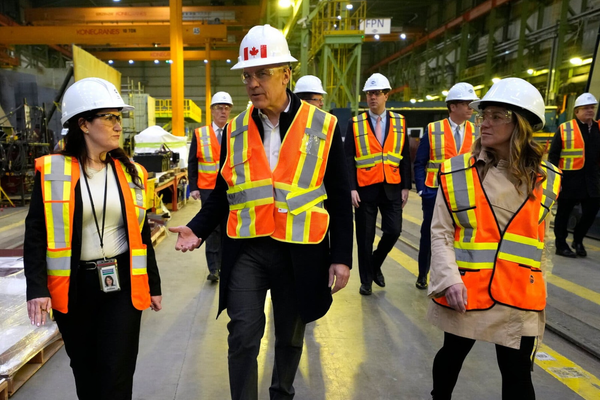
Canadian officials — with an election weeks away — have issued a similar call for action. On Wednesday, Mr. Carney’s campaign brought him to the bridge at the border with Detroit over which $300 million worth of auto parts cross daily. He unveiled a series of promises for the auto industry including a two billion Canadian dollar ($1.4 billion) fund to reshape it for a future without the United States.
“We will defend our workers, we will defend our companies, we will defend our country, and we will defend it together,” he said.
In Asia, officials had hoped for softer tariff treatment based on factories already being built in the United States at great expense. “We invest in America, employ people, and pay the highest wages,” Mr. Ishiba, the Japanese prime minister, said.
And yet, at a moment when economic and military threats seem to be converging for Japan, analysts said his hands were tied: Because inflation is rising with a weakened Japanese yen, Japan cannot afford a trade spat that drives up consumer prices even further. And with a more militarized China on Japan’s doorstep, sending armed ships to assert its claims to disputed islands in recent days, the prime minister is most keen to get a clear commitment from Mr. Trump to defend Japan’s security. Defense Secretary Pete Hegseth is scheduled to arrive in Tokyo this week.
So far, the Trump administration has sent conflicting signals to America’s largest Asian ally. While Secretary of State Marco Rubio has reaffirmed support for Japan, the president himself has publicly questioned the two nations’ security alliance.
“We are very much constrained at this moment,” said Ken Jimbo, a professor of international politics and security at Keio University.
South Korea finds itself in a similar position; it has deepened its diplomatic and military dependence on the United States in recent years, as anti-Chinese sentiment rose among its people, and to strengthen deterrence against North Korea.
South Koreans’ fundamental trust in the alliance will survive the latest tariffs, in part because the penalties didn’t target South Korea only but also hit competitors, said Park Won-gon, an expert in South Korea-U.S. relations at Ewha Womans University in Seoul.
But cars are one of South Korea’s biggest export items, totaling $71 billion last year, and the United States was the destination for nearly half. The government called for a meeting with the car industry on Thursday to discuss a response to the tariffs.
“The U.S. tariffs are expected to pose significant challenges for our automobile companies exporting a large volume to the U.S. market,” said Ahn Duk-geun, South Korea’s trade minister.
On news portals from the left and right, many Koreans expressed outrage that the tariffs were landing just a few days after Hyundai Motor, a South Korean conglomerate, said it would invest $21 billion to expand manufacturing in the United States.
William Choong, a senior fellow at the ISEAS – Yusof Ishak Institute in Singapore, said that for many Asian allies, it feels as if the United States is a police commander “that sticks his Glock down the back of the junior cop — i.e. regional countries — and starts shaking him down for cash and other valuables.”