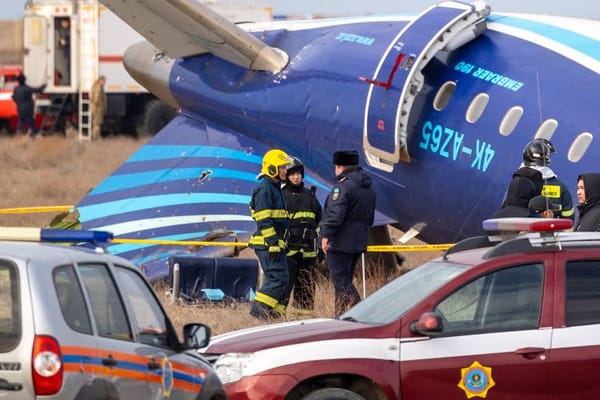
Azerbaijani president requests "admission of guilt" by Russia in plane crash.
#image_title

Azerbaijani president requests "admission of guilt" by Russia in plane crash.


Share this post

Azerbaijani President Ilham Aliyev blasted Russia for putting forward “absurd” theories initially and said Moscow must compensate victims’ families.

President of Azerbaijan, on Sunday, asked Russia to acknowledge its fault in the incident which resulted in the Christmas Day crash of one of passenger aircrafts, which claimed the lives of 38 people, to accept responsibility for it, and to compensate government and bereaved people.

First, the Russian side must apologize to Azerbaijan,” he said. “Second, it must admit its guilt. Third, those responsible must be punished, brought to criminal responsibility, and the Azerbaijani state, the affected passengers and crew members must be paid compensation.”

President Ilham Aliyev reported that Azerbaijan Airlines Flight 8243, an airplane loaded with 67 passengers and crew members that took off from Baku on Wednesday morning to fly into Grozny in the Russian Federation, became the victim of external damage and violently and beyond the hand of the controller" by electronic warfare. The tail of the Embraer 190, he said in televised remarks, was seriously damaged as a result of shelling from the ground.

Aliyev received an apology from Russian President Vladimir Putin on Saturday for the "tragic incident" near Grozny that has strained ties between the former Soviet neighbours.

According to a Kremlin version of their phone conversation, Putin informed Aliyev that Ukrainian drones had assaulted the region, triggering Russian air defences. However, it did not claim credit for bringing down the plane.

Flightradar24, a tracking firm, released the flight path, which revealed that the aircraft had been "exposed to GPS jamming and spoofing near Grozny." When it comes to drone defence, radar jamming is commonly used.

The aircraft crashed close to Aktau in southwest Kazakhstan, almost 270 miles across the Caspian Sea, after being diverted from Grozny in midair.

At first, Russian officials proposed that an oxygen tank on board exploded, blamed bad weather in Grozny, and conjectured that the plane struck a flock of birds.

After that, survivors uploaded videos demonstrating that shrapnel had perforated the fuselage and injured multiple people, while Kazakh officials released images revealing holes in the plane's tail.

As unrealistic, independent aviation analysts rejected the bird theory. According to them, the damage was more in line with a hit with a tiny surface-to-air missile, like the Pantsir system, which Russia deploys to thwart drone assaults from Ukraine.

Aliyev declared on Sunday that he was "surprised and upset" that Russian officials did not immediately accept responsibility and instead offered fictitious explanations. It was clear, Aliyev emphasised, that the plane had not been shot down on purpose.

However, he asserted that Russia ought to have shown regret and acknowledged its mistake to "the friendly state" of Azerbaijan.

Share this post
Comments

Be the first to know

Join our community and get notified about upcoming stories

Subscribing...
You've been subscribed!
Something went wrong
Antonelli suffers car crash ahead of first pre-season test

Antonelli suffers car crash ahead of first pre-season test

Mercedes driver Kimi Antonelli was involved in a car cash close to his home in San Marino ahead of this weekend’s Formula 1 pre-season test in Bahrain. The 19-year-old was however unharmed in the incident which happened over the weekend and will be able to take part in the first test at the Bahrain International Circuit. Mercedes in a statement said: “We can confirm that Kimi was involved in a traffic accident on Saturday night close to his home in San Marino. “The police attended the scene,


O A

Ukraine Shifts From Drone Buyer to Drone Exporter

Ukraine Shifts From Drone Buyer to Drone Exporter

Ukraine is preparing to open 10 weapons export centers across Europe and begin production of Ukrainian‑designed drones in Germany, marking a shift from wartime arms recipient to emerging arms exporter. President Volodymyr Zelenskyy told students at the Kyiv Aviation Institute that the export hubs—planned for 2026 across the Baltic and Northern European states—will sell systems built with Ukrainian technology, with German production to start in mid‑February and lines already running in the UK. A


B P

New Science Books Argue That Art, the Internet, and Weight‑Loss Drugs Are Quietly Rewiring Our Lives

New Science Books Argue That Art, the Internet, and Weight‑Loss Drugs Are Quietly Rewiring Our Lives

February’s batch of popular science books leans into big‑picture questions about the universe, the climate and our own bodies, framed as winter‑reading picks in New Scientist’s roundup of the month’s best new titles. Space scientist Maggie Aderin’s memoir “Starchild” anchors the list, weaving her work on satellites and the moon together with the story of raising a daughter and finding wonder in the night sky. Set against January’s offerings, where Daisy Fancourt’s “Art Cure” argued that concert


B P

Venezuela’s Maduro Faces U.S. Narco‑Terrorism Case in New York

Venezuela’s Maduro Faces U.S. Narco‑Terrorism Case in New York

Venezuela’s ousted president Nicolás Maduro is in U.S. federal custody in New York, where he and his wife, Cilia Flores, face a superseding indictment in the Southern District of New York on narco‑terrorism, cocaine‑importation conspiracy, weapons and related charges. Prosecutors allege that for years Maduro and senior Venezuelan officials worked with Colombian guerrilla groups and traffickers to move large quantities of cocaine from Venezuela toward the United States, using state resources and


B P